Judul : KDI Unveils Sharp Critiques of Government Budget Policies
link : KDI Unveils Sharp Critiques of Government Budget Policies
KDI Unveils Sharp Critiques of Government Budget Policies
A new study from the state-backed Korea Development Institute (KDI) has drawn significant public interest. This is due to its ability to uncover the core of the challenges confronting the South Korean economy and reveal its true conditions. Within the economic community, there are opinions that "KDI is offering a model solution for overcoming the 'trap of slow growth.'"
Significantly, the report has gained notice for its direct arguments that may place a burden on the current administration, which is vigorously advocating expansionary fiscal measures, including injecting public funds and encouraging cash-based initiatives like private consumption vouchers and rural basic income. Critics have noted that it is uncommon for a state-affiliated research body, usually expected to align with governmental views, to present such "forceful" criticisms.
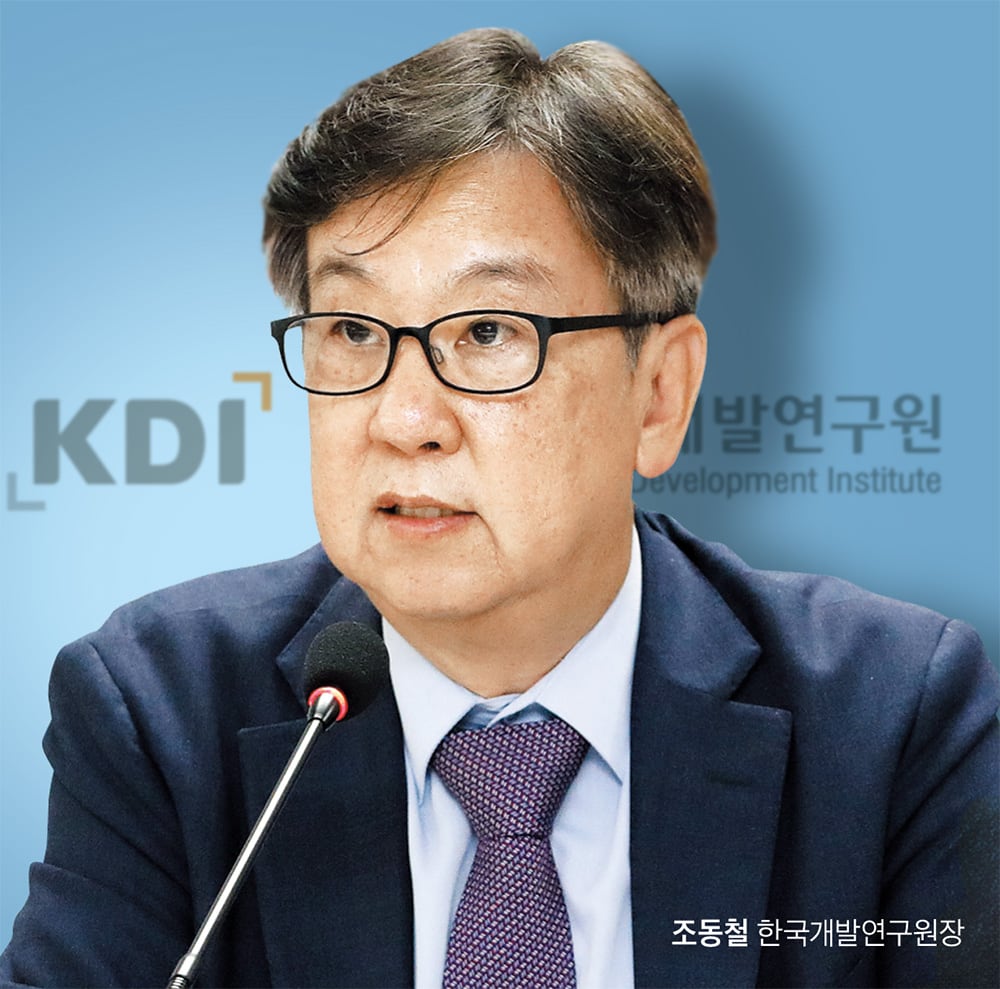
◇KDI Says 'Struck Hard'
The most notable recent analysis came from KDI's direct expression of worry regarding the current government's financial strategy designed to boost the economy through increased state funding. On the 11th, KDI released its economic forecast for the second half of the year, noting, "It is recommended to gradually return to a more neutral fiscal policy as the economy recovers." It further stated, "Measures must be taken to avoid large fiscal deficits becoming a long-term issue." These statements were uncomfortable for the Lee Jae-myung administration, which has advocated for cash-focused initiatives like raising next year's budget by a historic 55 trillion won to 728 trillion won, issuing private consumption vouchers, and introducing a rural basic income. KDI emphasized its warning, saying, "Over-reliance on economic stimulus should be closely monitored."
Earlier this month, KDI also pointed out that "low unemployment rates may not necessarily indicate an improvement in employment." This has put the government in an awkward position, as it has consistently highlighted "record-low unemployment rates and the highest employment levels ever" whenever employment data is released. According to KDI, the unemployment rate has stayed within the 2% range for years, even as growth slowed, due to an increase in people who have stopped searching for jobs. As the employment downturn has continued, the number of "discouraged" young people who have given up on finding work has grown, which has lowered the number of unemployed individuals. This has resulted in a "mirage" where the unemployment rate—calculated by dividing the number of unemployed by the economically active population—has declined.
That's not all. KDI has repeatedly stated that for the Korean economy to escape low growth, it needs to cut welfare expenditures, which are rising because of declining birth rates and an aging population, address low productivity to encourage business investment, and remove "zombie companies" that can't even cover their interest costs with their profits. In a report published last May, KDI cautioned, "If productivity remains at its current level without structural economic reforms, the potential growth rate could drop to nearly zero by the 2040s."
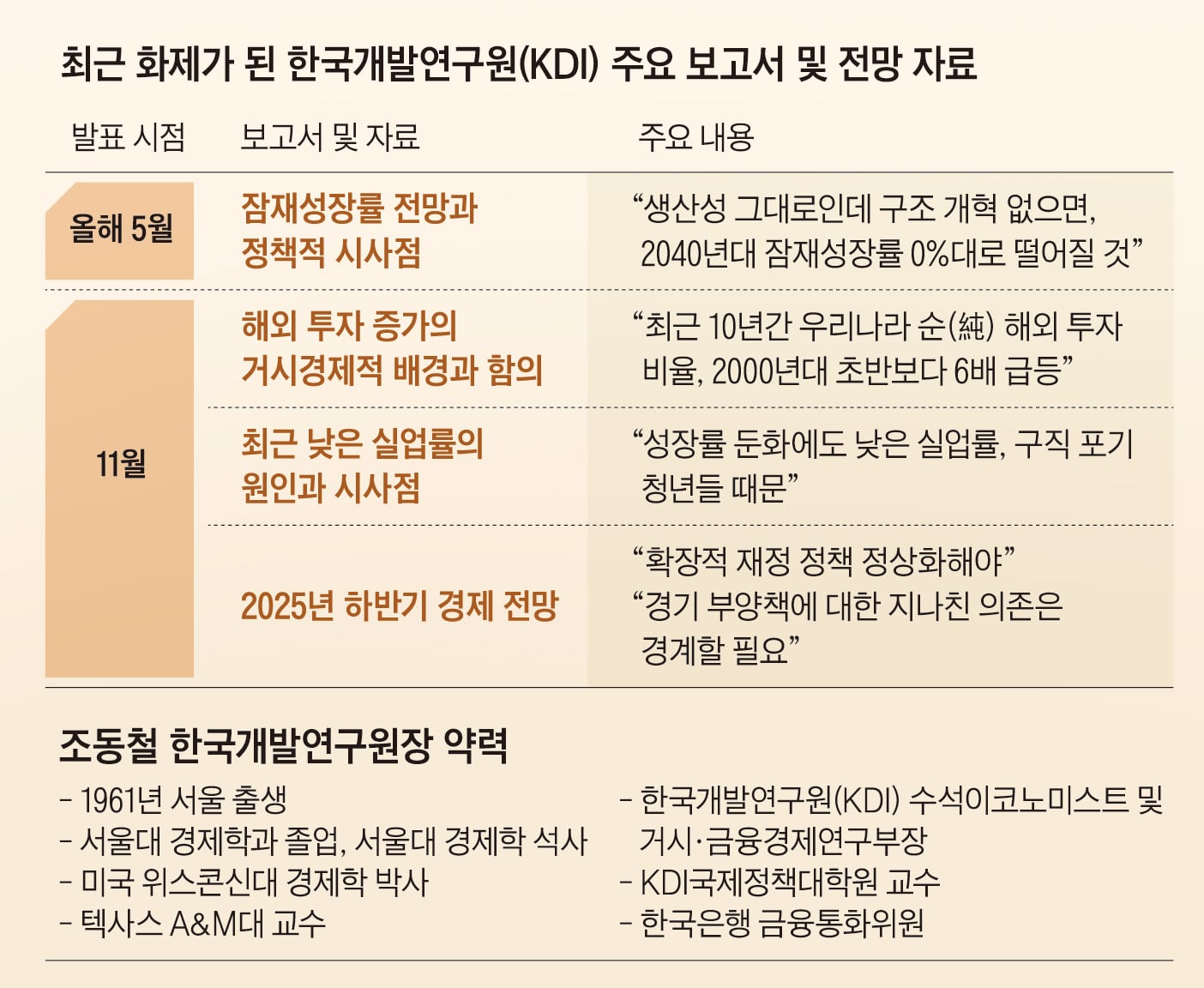
◇Cho Dong-chul, Director, Supports Unrestricted Research
Some believe that KDI's firm position stems from the philosophy of Director Cho Dong-chul, who promotes free research. Director Cho, who assumed his role in December 2022, is an economist with strong ties to KDI, having previously worked as a senior economist, head of the Macroeconomic Research Division, and professor at the Graduate School of International Policy Studies. As someone who deeply understands the role KDI—home to the nation's leading economic experts—should play in the Korean economy, he has created an environment where KDI expresses its views without hesitation. While serving on the Bank of Korea’s Monetary Policy Committee from 2016 to 2020, Director Cho was recognized as a pragmatic and realistic dove (favoring monetary easing). At that time, he strongly criticized the Bank of Korea for its passive approach to interest rate reductions, despite the Korean economy facing slow growth and low inflation.
A KDI representative stated, “Including studies commissioned by others, KDI issues approximately 300 reports each year. The director is unable to examine every report, and most are published with the researchers' views without significant limitations.” However, the source mentioned, “Director Cho thoroughly reviews only the outlook reports and materials released under KDI’s name, not the individual works of researchers.”
Director Cho, who is set to resign at the end of this month, stated, "The potential growth rate keeps declining—don't you see what the issue is?" He further mentioned, "KDI has consistently expressed its views since I took office, not just in recent times, and there's been no change."
Thus the article KDI Unveils Sharp Critiques of Government Budget Policies
You are now reading the article KDI Unveils Sharp Critiques of Government Budget Policies with the link addresshttps://www.angkaraja.cfd/2025/11/kdi-unveils-sharp-critiques-of.html
0 Response to "KDI Unveils Sharp Critiques of Government Budget Policies"
Post a Comment