Judul : LG Electronics Secures Century Communities Contract for U.S. Built-In Appliances
link : LG Electronics Secures Century Communities Contract for U.S. Built-In Appliances
LG Electronics Secures Century Communities Contract for U.S. Built-In Appliances
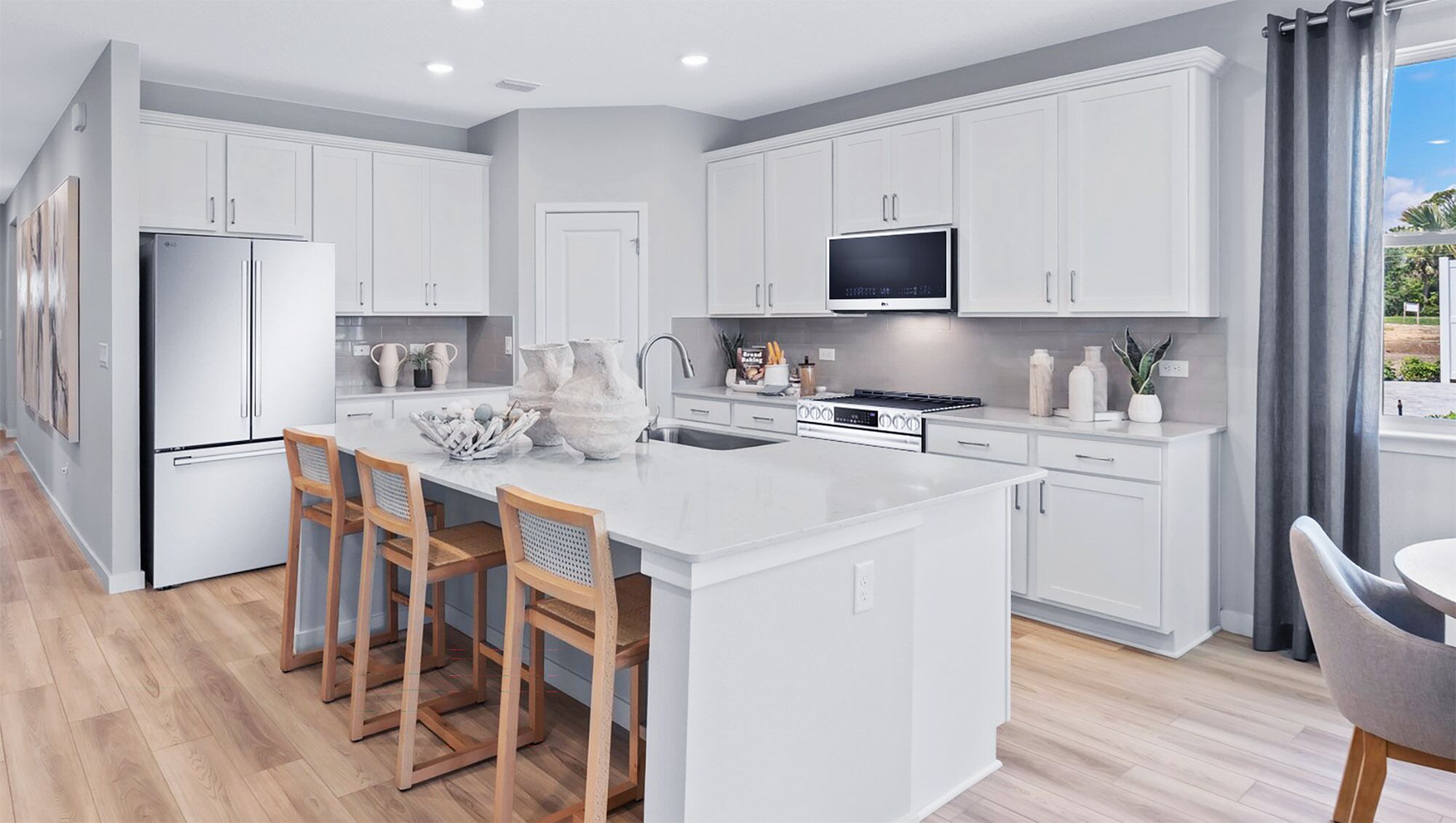
LG Electronics recently signed an exclusive supply contract for home appliances with Century Communities, a major U.S. ‘builder’ (construction company). A builder refers to a company that constructs residential or commercial buildings and installs appliances as built-in units. This marks LG Electronics’ expansion of its U.S. B2B (business-to-business) built-in appliance business by partnering with a large U.S. builder company.
Century Communities is one of the top 10 builders in the U.S. The contract runs until 2029. All of the tens of thousands of new homes that Century Communities builds in the U.S. will feature LG Electronics’ high-efficiency and AI-equipped appliances, including refrigerators, washing machines, dryers, dishwashers, and ovens.
Domestic home appliance companies are targeting the built-in appliance market. Built-in appliances are those installed as fixed units within a home to avoid protruding. They must be installed in limited spaces and meet high quality standards. While local companies such as Whirlpool, GE, and Miele have dominated the built-in appliance market in overseas regions like the U.S. and Europe, Korean companies’ technological capabilities have recently begun to gain recognition. LG Electronics recorded sales growth of over 70% in the builder business segment during the first half of this year compared to the same period last year. This represents approximately a 2.5-fold increase compared to the same period in 2023.
Notably, Korean home appliance companies are gaining competitive recognition by introducing appliances that perfectly fit residential spaces, leveraging core built-in appliance technologies such as hinges and heat dissipation.
◇ Strengthening the Built-in Market Strategy
Until now, Korean companies have found it difficult to enter overseas built-in markets. This is because housing construction companies typically sign contracts with local appliance manufacturers from the outset of building projects. For example, Whirlpool and GE are prominent in the U.S., while Miele leads in Europe.
However, as Korean home appliance companies’ recognition in these B2B markets has grown recently, the market has gradually begun to open up. A source from the home appliance industry said, “Korea is receiving high praise not only for its outstanding technological capabilities but also for its after-sales service (AS).” In this context, Samsung Electronics and LG Electronics have launched premium built-in kitchen appliance brands, ‘Dayco’ and ‘SKS’ respectively, focusing on global market expansion.
According to market analysis firm Data Bridge Market Research, the built-in appliance market is projected to grow from $26.11 billion (approximately 37.9 trillion Korean won) last year to $37.41 billion (approximately 54.2 trillion Korean won) by 2032.
The core of built-in appliances lies in kitchen furniture. Korean appliance companies are releasing appliances that can be installed even in very narrow spaces and feature sophisticated designs. Samsung Electronics’ refrigerators can be perfectly installed with just a 4 mm gap on either side of the refrigerator cabinet. A 4 mm gap is equivalent to the thickness of two 500-won coins. Even when installed closely against adjacent furniture, the refrigerator door can open over 90 degrees. This is achieved by adjusting the hinge’s axis position during design to reduce corner protrusion when the door is opened. By reducing the insulation material thickness to 8 mm, the interior door storage space for beverages and sauces has been increased by 22%. Compared to conventional refrigerators, the capacity has been expanded by 25 liters, overcoming volume limitations.
The dishwasher, installed alongside the cabinet, has no handle. It opens when a sensor detects a hand nearby. Samsung Electronics stated, “It allows for a cohesive kitchen interior design.” LG Electronics also introduced a refrigerator that can be installed even with a 4 mm gap between walls. This model features a new hinge technology. It uses a dual-axis hinge that creates a rotating path inward when the refrigerator door is opened. When the door is opened, the corner slightly retracts into the refrigerator to prevent collision with the wall.
A front heat dissipation technology has been applied, which inhales and exhausts air from the front of the refrigerator. Previously, heat was expelled from the rear, often requiring wider gaps between the refrigerator’s back and surrounding furniture to allow heat escape. In cases where the installation space wasn’t deep enough, the refrigerator would protrude forward beyond the surrounding furniture to accommodate the rear gap. This technology minimizes the required rear gap. LG Electronics is expanding its built-in appliance lineup, including an ‘integrated hood’ that can be stored inside the countertop when not in use and combined oven and induction cooktop products.
◇ Chinese Companies Also Catching Up
Thus the article LG Electronics Secures Century Communities Contract for U.S. Built-In Appliances
You are now reading the article LG Electronics Secures Century Communities Contract for U.S. Built-In Appliances with the link addresshttps://www.angkaraja.cfd/2025/10/lg-electronics-secures-century.html
0 Response to "LG Electronics Secures Century Communities Contract for U.S. Built-In Appliances"
Post a Comment