Judul : Peking University's Face Tech Triggers Privacy Controversy
link : Peking University's Face Tech Triggers Privacy Controversy
Peking University's Face Tech Triggers Privacy Controversy
This is Lee Beol-chan from Beijing. Every Friday on Chosun Membership, we examine one of the 'uncomfortable truths' that lie behind China's technological progress. Companies promoting excessive work hours, systems for nurturing genius, a society that has become numb, undisclosed tactics, and state-driven long-term planning... We have overlooked these elements of China for too long. It's time to observe them with our own eyes and think about how to respond.
When I recently visited my alma mater, Peking University, I couldn't even hide my face for a second. This was because identity verification using a 'facial recognition' system was necessary not only at the main gate of the school but also at the entrances of the library and cafeteria. Although it was convenient to enter any place just by showing my face, it made me feel uncomfortable. During my time as a producer for a campus broadcast current affairs program in 2008, I used to secretly carry a school camera, conduct anonymous interviews in empty classrooms, or report on protests in front of the school gate. Such a sense of romance is now gone.
Cai Yuanpei, who was the president of Peking University, established the school's motto, "Freedom of thought, openness to all." Although I am unsure about the freedom of thought, the university is definitely showing inclusiveness in terms of facial recognition.
In South Korea, this kind of scenario would lead to public complaints, being seen as the emergence of a 'Big Brother society.' However, in China, it has become a normal part of everyday life. Even Li Kaifu, former head of Google China and known as the 'AI godfather' in the country, remarked, "Chinese consumers have low expectations regarding privacy protection and are willing to sacrifice it for convenience." This explains why technologies like facial recognition, palm-based payments, driverless taxis, and robot police, which encounter social resistance and slow acceptance elsewhere, are progressing rapidly in China.
This is not something to ridicule or simply watch. Interestingly, the global community is keeping pace with the advancement of sensitive technologies in China. South Korea, which previously raised worries about deploying AI surveillance cameras, is now examining 'CCTV density' (a study revealed there are 2 million CCTV cameras in public facilities in South Korea, with over 20 million when private ones are included). Public opinion, which once resisted adopting facial recognition, has also become more accepting following the COVID-19 pandemic. It is technology, rather than institutions, that is reshaping the system. There are indications that these sensitive technologies, impacting 1.4 billion Chinese citizens, may progressively evolve and establish themselves as global standards.
◇Following the 1 Billion AI Cameras: Police Robot Squadrons
As residents of a nation that holds the highest number of surveillance cameras globally, Chinese individuals are quietly tolerating the encroachment on their personal data and privacy. According to a British cybersecurity company named Comparitech, by 2024, more than 1 billion closed-circuit television (CCTV) cameras had been deployed throughout China. This equates to 372 cameras for every 1,000 urban dwellers, which is eight times the figure in the United States. All these cameras are linked to artificial intelligence systems. During the three-year COVID-19 lockdown (2020–2022), the entire population also participated in 'training' by voluntarily tracking their movements through an app and informing the government.
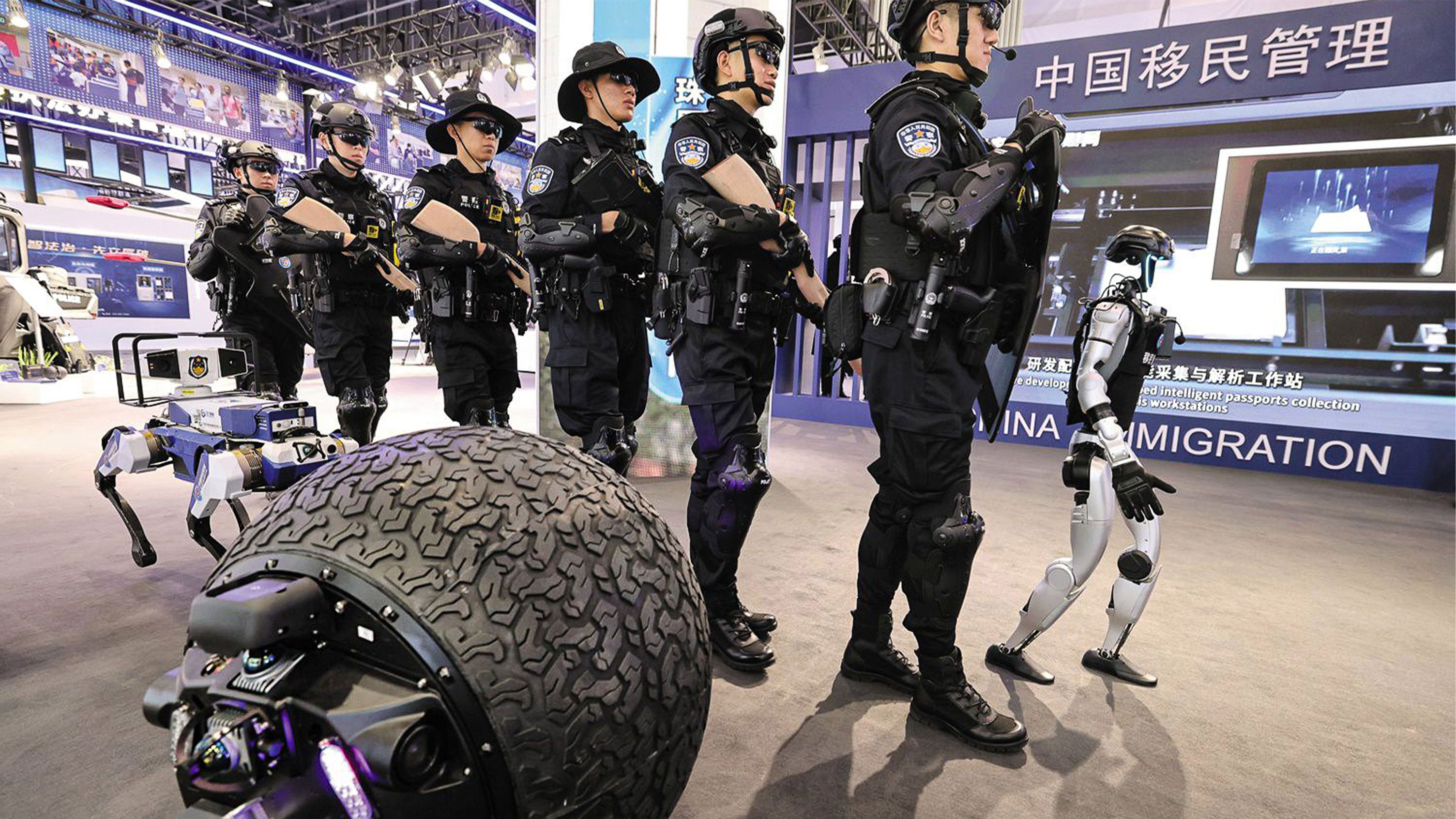
After the nationwide surveillance cameras, the advanced technology supported by the Chinese government is 'police robots.' Since last December, robust-tired police robots have been placed on the streets of Wenzhou, a coastal city in eastern China. They can recognize wanted people using facial recognition, drive independently at 35 km/h, and shoot net guns.
Nevertheless, when the robot was initially presented to the public by researchers from Zhejiang University in October 2024, it was categorized as a military tool because of its ability to operate in water and conduct explosive attacks.
The article continues via the link below
https://www.chosun.com/economy/int_economy/2025/11/14/SE2O2MQWQNCUHJSVH56SQ5LDZE/
◇New Posts from Chosun Membership
Doctor Who Stopped Smoking at 70 Continues Riding Horses at 90... Investigating His Nap Habits
https://www.chosun.com/medical/2025/10/31/NYEYY7MAJJHKJGREMQUK4Y3RGI/
Cemetery for Foreigners Adjacent to 'Hip Hapjeong-dong'... So Comfortable It's Hard to Believe
https://www.chosun.com/culture-life/2025/11/13/PQXO5736JZBJTNT5QDH5ES67AM/
The Renowned Scientist Who Verified Einstein's Last Theory
https://www.chosun.com/premium/2025/11/14/WK7MKB23VVH3HP253NTD6XCDRA/
Thus the article Peking University's Face Tech Triggers Privacy Controversy
You are now reading the article Peking University's Face Tech Triggers Privacy Controversy with the link addresshttps://www.angkaraja.cfd/2025/11/peking-universitys-face-tech-triggers.html
0 Response to "Peking University's Face Tech Triggers Privacy Controversy"
Post a Comment